

The Profitable Cycle of New Tibia Servers
Understand how new servers, Tibia Coins, wars and merges form a profitable cycle in Tibia—and why this model divides the community.
Tibia is going through one of its strongest financial periods. CipSoft itself has already stated that the game achieved record revenues repeatedly and exceeded €200 million in cumulative revenue as early as 2022. At the same time, the company continues to launch new worlds frequently and, shortly afterward, announce mergers between servers that have lost population.
At first glance, there is a contradiction.
If the game is healthy, why do so many servers need to be merged?
The simplest explanation would be that the population is not evenly distributed. Tibia may have thousands of active players and still have empty worlds while others remain full.
But another discussion has been circulating within the community for years: the possibility that the cycle of launching worlds, blocking transfers, fueling an initial race and then carrying out merges is financially advantageous for CipSoft.
There is no official statement confirming that this is the company’s intention.
However, when we look at the frequency of new servers, player behavior, the rising value of the early economy and conflicts between dominant guilds, it becomes difficult to ignore how much money this cycle moves.
CipSoft has not stopped creating new worlds
In 2025 alone, CipSoft opened several sets of servers throughout the year.
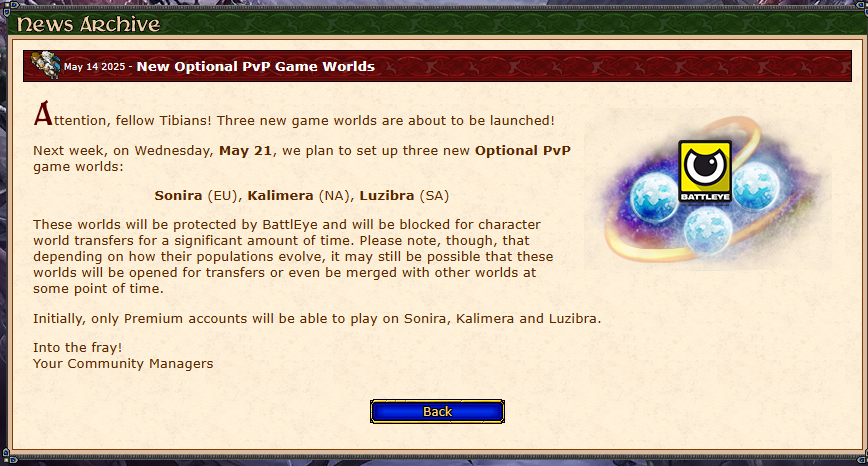
In May 2025, Sonira, Kalimera and Luzibra were announced, all Optional PvP. In August, Escura, Mystera and Penumbra went live. In October, the company announced three more worlds: two Open PvP and one Optional PvP.
And the pace continued in 2026.
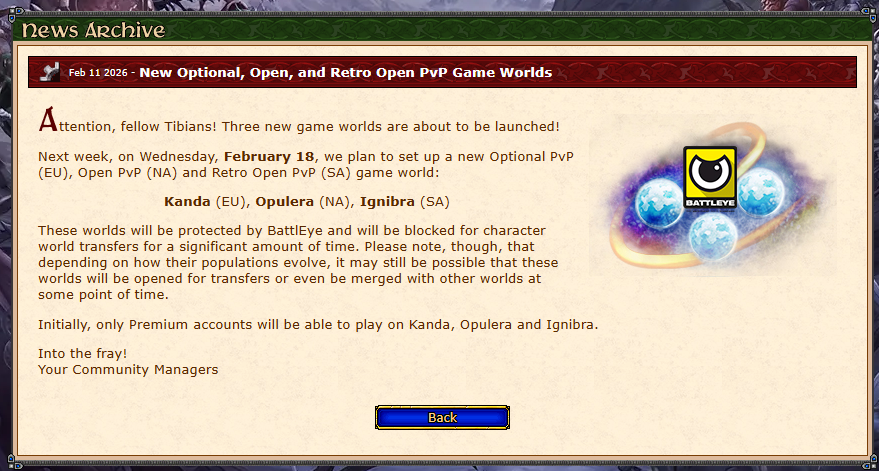
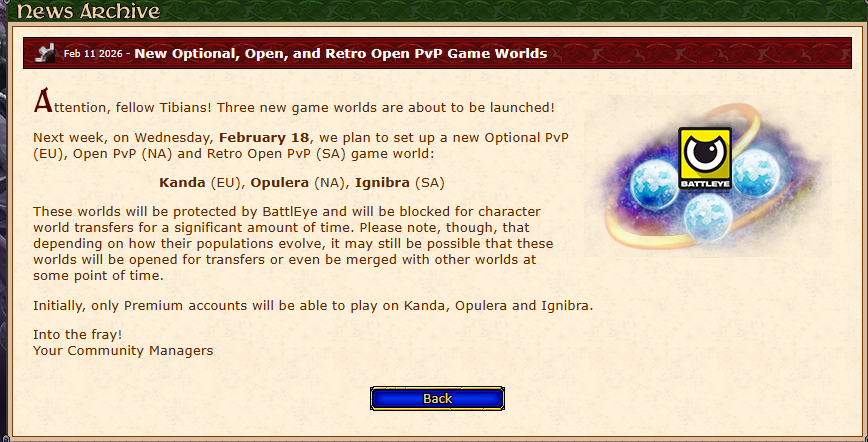
In February, CipSoft launched Kanda, in Europe; Opulera, in North America; and Ignibra, in South America. In May, only three months later, Maligna, Junera and Floribra arrived.
By July 2026, therefore, another six worlds had already gone live.
We are not talking about an occasional opening caused by an unexpected increase in players.
New servers have become a recurring part of Tibia’s calendar.
And all of them follow a well-known formula.
They begin closed to transfers for a period that CipSoft usually describes only as “significant.” In many cases, they are also initially exclusive to Premium accounts.
This means that nobody can simply enter with an old character carrying years of progress, high skills, equipment and an accumulated fortune.
Everyone has to start again.
Or, at least, everyone has to create a new character.
Financially, not everyone starts from the same position.
In practice, the launch of new worlds no longer appears to be an emergency response to an excess of players.
It has become a recurring part of the game’s calendar.
What makes a new world so attractive?
On an old server, the top ranking positions are already occupied.
There are characters with years of training, large amounts of gold in circulation, rare equipment, established guilds and players who have been accumulating resources since long before any newcomer arrived.
In a newly launched world, everything starts from zero.
There are no extremely advanced characters. There are no old stockpiles of items. The supply of equipment, resources and creature products is limited. Even objects considered common on old servers can have great value during the first few weeks.
In addition, new worlds normally begin closed to transfers. CipSoft confirms in its own announcements that these servers go live without allowing transferred characters to enter.
This creates a rare window within Tibia:
For a while, nobody can simply import an old, powerful and fully equipped character.
Anyone who wants to compete for the top must begin alongside everyone else.
And that is exactly where the race begins.
On a new server, speed is worth money
During the first few days, practically everything is scarce.
Certain resources depend on players capable of tackling content that most others have not yet reached. In addition, Tibia Coins can be officially traded on the Market. This allows a player to buy Coins with real money and sell them to other players in exchange for gold.
On an old server, where a great deal of gold is already circulating, this exchange takes place within a mature economy.
On a newly created server, the situation is different.
There is little money available, but many people are interested in progressing quickly. This makes every amount of gold especially valuable during the first few days.
Players who own Tibia Coins can sell them to buy equipment, supplies and resources that other players still need to obtain slowly.
Not to mention that the Store offers progression-related products such as XP Boosts and Exercise Weapons. Services such as Character World Transfer are also purchased with Tibia Coins once the worlds finally allow this kind of movement.
This does not mean that spending money is enough to dominate a server. A guild still needs organization, knowledge, active players and the ability to defeat its opponents.
But money can reduce the time required to obtain certain advantages.
In a new world, veterans voluntarily return to level 1.
They start over without strong characters, but not necessarily without a budget.
This difference is essential to understanding why each opening can turn into a highly profitable event.
The limited economy increases the demand for Tibia Coins
On an old server, a player can buy gold produced over many years by a mature economy.
On a new server, that stockpile does not exist.
The gold must be created by the players themselves, creature by creature. At the same time, there is enormous demand for the resources needed to accelerate character progression.
This means that the value of gold relative to Tibia Coins can be very different from what is found on old worlds.
The more valuable the in-game currency becomes, the greater the purchasing power obtained by those who sell Tibia Coins on the Market.
For players interested only in a casual experience, this may not make much difference.
For teams competing for rankings, territories, hunting grounds and control of the server, every early advantage matters.
Premium Time, boosts, Exercise Weapons, Store Inbox and other official products are also part of a monetization structure based on Tibia Coins. Therefore, even though CipSoft does not disclose how much each new world generates individually, the competitive environment encourages the consumption of products that accelerate or facilitate progression.
This is an important point: there is no public data showing how much CipSoft earns specifically from the opening of each server.
The connection is an economic inference based on the structure of the game and the behavior reported by players, not information confirmed by the company.
Even so, this perception is far from isolated.
In community discussions, players repeatedly accuse CipSoft of launching servers to attract people willing to invest heavily in the initial race. Some summarize the model as a repetition of new worlds every few months, followed by later mergers. Others note that highly competitive players spend large amounts when they decide to start over.
Yes, I know these statements represent community opinions, not proof of CipSoft’s internal strategy, but they reveal how part of the public sees the cycle.
The real prize is not just the top level
A new server does not represent only the opportunity to reach the top level.
For organized guilds, it represents an unclaimed territory and, in some cases, a territory that can become a source of income.
On old worlds, power relations are already established. There are alliances, historical enemies, informal rules and groups that have controlled certain areas for years.
On a newly opened server, all of this still has to be built (theoretically).
The guild that advances the fastest can occupy the best respawns, recruit important players, accumulate resources and prevent its opponents from keeping pace with its progress.
But we all know that, in reality, these cards were dealt long before any player even set foot in that new world.
In this scenario, level and money no longer represent only individual progress.
They become political power, and political power can become economic power.
Recurring community reports describe dominant guilds that charge guild bank, usually paid in Tibia Coins, as well as fees for entry, protection or permission to remain on the server. There are also accusations of charges imposed on players who buy high-level characters or want to use certain areas without being hunted.
Charging in Tibia Coins creates a boundary that is difficult to separate.
Coins are an official product purchased with real money, but they can be transferred between players and traded for gold on the Market. Thus, even when a charge takes place only within the game, the resource involved has economic value outside it.
Part of the community claims that guild leaders accumulate these Coins, sell gold, trade rare items or convert resources obtained in the game into real money. Some players even treat server domination as an activity capable of generating income. However, the amounts cited publicly are almost always estimates, personal accounts or accusations without independent documentation.
CipSoft does not recognize this parallel market as an official part of the game. Its rules prohibit advertising transactions involving real money, including the purchase or sale of Tibia items for money. Therefore, it would not be correct to claim that the company directly authorizes this kind of trade.
The most controversial point lies elsewhere.
Although direct trade for real money is prohibited, the system of domination, guild bank charges, respawn control, persecution of opponents and payment in Tibia Coins, continues to exist within the possibilities offered by the game itself.
In practice, CipSoft does not recognize dominant guilds as authorities, but it also does not prevent them from creating informal rules and using their strength to charge for participation in this structure, as long as they do not openly advertise a transaction for real money.
Thus, the company does not officially accept the parallel market, but it ends up tolerating the environment that allows it to operate.
Those who control the best locations progress faster. Those who progress faster can maintain control. Those who control respawns, bosses and resources can charge people who want to participate in that world, or concentrate items and gold to trade them later.
Control strengthens progression, progression strengthens domination, and domination, on certain servers, can cease to be merely an achievement within the game and become a business.
That is why the dispute begins on the first day. Guilds are not fighting only for a place in the rankings.
They may be fighting for control of an entire economy.
New worlds are perfect battlegrounds for wars
When an Open PvP or Retro PvP server is announced, large groups may see the opening as an opportunity.
Everyone begins without the protection of old transferred characters. The guild that can organize more players, progress faster and build an economic advantage during the first few weeks may try to prevent rivals from keeping pace with its growth.
The war, therefore, does not necessarily begin when the characters are ready.
It begins in the race for resources.
Whoever controls the first important areas can progress more. Whoever progresses more can fight with an advantage. Whoever wins the first clashes may drive out opponents or hinder their progression. Whoever loses must invest more, reorganize or abandon the world.
Community coverage of the servers launched in 2025 clearly shows this competitive interest. Penumbra, for example, received videos dedicated to the war on that world shortly after its opening, while content creators directly promoted the new PvP worlds as environments for conflict.
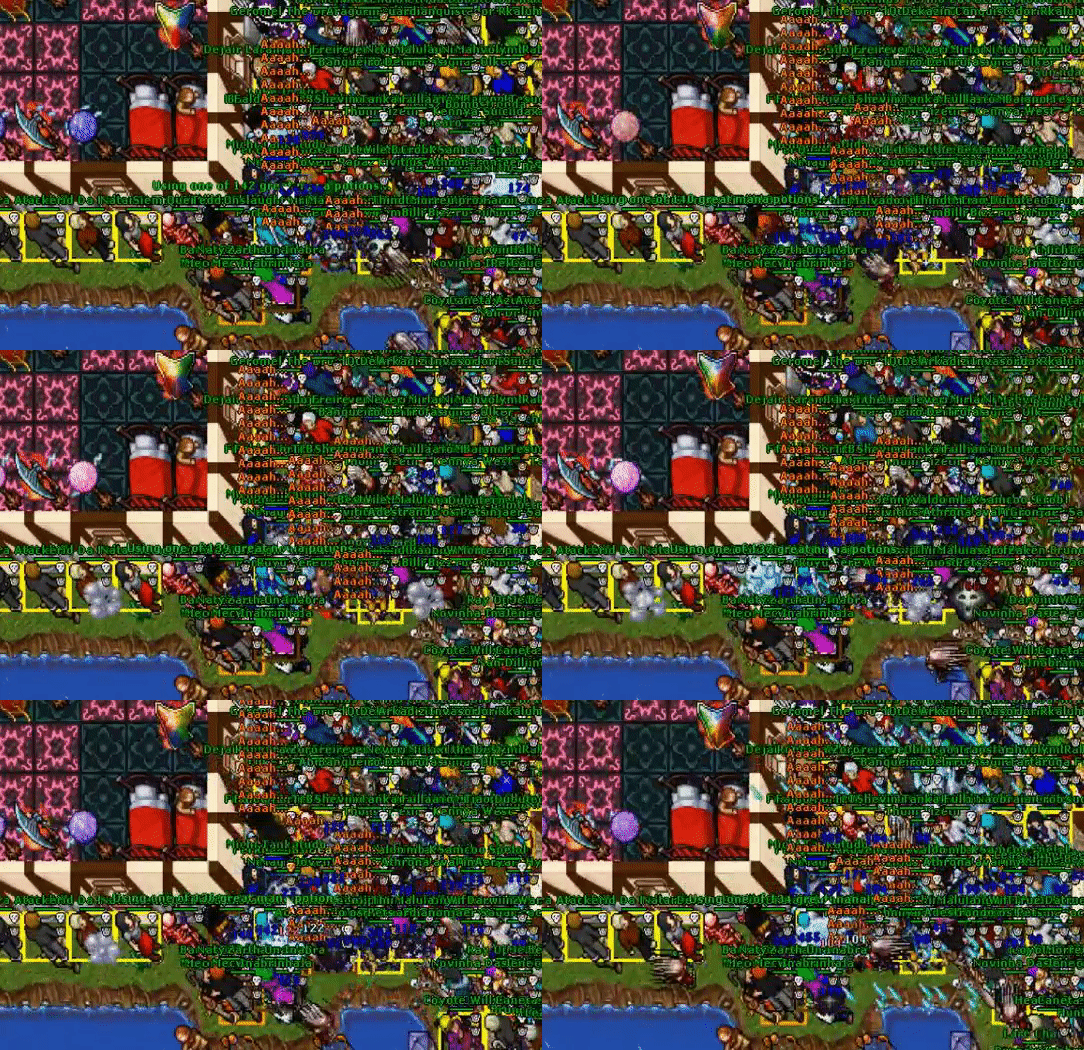
These videos prove that clashes occurred and that there was community interest in the war, but they are not enough on their own to determine all participants, winners or political structures of the server.
For this reason, it would be premature to attribute definitive control to a specific guild without following death records, guilds and characters over a longer period.
War also drives spending
A prolonged war requires resources.
Players need to keep characters active, recover losses, acquire supplies, reorganize teams and, in some cases, transfer characters between worlds when this becomes permitted.

The official Character World Transfer service itself imposes rules related to the PvP type and the conditions of each world. CipSoft’s documentation also confirms that some servers may remain closed to incoming transfers even when outgoing transfers are permitted.
Within the community, players frequently associate wars and mergers with spending on transfers.
During the discussion about the merge involving Damora and Nadora, for example, users reported that players had left one of the worlds because of local disputes and feared being reunited with the same groups after the merger. Some explicitly mentioned the cost of another transfer to escape the conflict.
Another comment pointed out that guilds that had already fought each other in the past could meet again after a merge, creating a new war between the most economically active groups on the servers involved.
Again, these are player interpretations, but they show that merges do not merely combine databases.
They combine histories, rivalries and power structures.
The merge solves the emptiness and creates a new conflict
When a world loses population, several problems begin to appear.
The Market has fewer offers. Certain services become difficult to find. Guilds disappear. Social life declines. Activities that depend on groups become more complicated.
In these cases, merging servers can be a legitimate measure.
The merger increases the population, stimulates the economy and brings together players who were isolated on worlds with little activity.
In November 2025, for example, CipSoft scheduled the creation of Xymera from Vandera and Runera; Blumera from Ulera, Vitera and Esmera; and Monstera from Wildera and Gravitera.
However, a merge does not bring together only neutral players looking for company. It can also place two or three dominant guilds within the same territory.
If each group was accustomed to controlling its previous world, someone will have to give up space.
And in Tibia, that often means conflict.
Community discussion about merges demonstrates this expectation. In the case of Damora and Nadora, players predicted an extremely troubled world after the union and reported that part of the population had already moved precisely to avoid the dominant groups encountered before.
In other words:
The server empties, is merged with another world and immediately faces a new struggle for control.
This war can revitalize the server, but it can also drive neutral players away and start a new wave of transfers. After all, while the arrival of a war can make the server more active on one hand, neutral players may feel the opposite effect on the other.
Respawns may become contested, characters may be pressured because of their relationships with certain guilds and part of the population may decide to change worlds.
The merger may solve the problem of low population in the short term, but it does not automatically eliminate the social conflicts that helped empty certain worlds.
Could CipSoft be creating the problem it later needs to solve?
That is the central question.
The cycle observed by the community works more or less like this:
- CipSoft opens new worlds.
- Players leave old servers to start again.
- The population becomes divided among a larger number of worlds.
- The early economy increases the value of gold and items.
- Guilds compete to establish control quickly.
- Some players invest to keep pace with the race.
- The initial enthusiasm declines.
- Some worlds lose population.
- CipSoft carries out merges.
- Guilds from different servers are placed together.
- New disputes, departures and transfers arise.
- Other worlds are launched and the process begins again.
The community already calls this behavior a “launch and merge” strategy: launch servers, take advantage of the initial race and merge them when the population falls. In a 2025 discussion, players said they were tired of this model and criticized the repetition of worlds that end up being merged after one or two years.
This sequence exists and can be observed.
There is no public document showing that CipSoft deliberately opens worlds to empty other servers, provoke wars or force players to spend money.
What does exist is a model that, intentionally or not, creates clear financial incentives.
But opening servers also has legitimate justifications
It would be unfair to claim that every new server exists only to generate money. Some players genuinely enjoy starting over.
On old worlds, reaching the top positions can be practically impossible for someone who has just arrived. On a new server, however, everyone starts on the same date and must rebuild their characters and economy.
These worlds can also serve different regions and PvP styles. In 2026, for example, CipSoft did not open six identical servers. There were Optional PvP, Open PvP and Retro Open PvP worlds distributed across Europe, North America and South America.
In addition, part of the community compares these restarts to seasons in other games. The appeal lies in the initial race, the scarcity of equipment and the feeling that everything must be earned again.
The problem, therefore, is not simply the existence of new worlds.
The question concerns how frequently they are opened and whether their populations are sustainable in the long term.
Tibia can grow and still have empty servers
Revenue and population are not the same thing.
Tibia can generate more revenue even without distributing its players evenly among all worlds.
A smaller group of highly engaged players can spend more on Premium Time, Tibia Coins, services and official products than a larger population that is less willing to spend.
It is also possible for a new server to have a great deal of activity during its first months and then lose some of its players to other worlds, the Bazaar or simply to quitting the game.
Therefore, these two scenarios can coexist:
- Tibia can be financially healthy;
- some servers can be empty or have little activity.
This helps explain why the game’s growth does not prevent merges from taking place.
It also helps explain why opening new worlds can remain attractive even when they do not stay full forever.
So do new worlds exist to generate money?
Financial returns are likely an important part of the decision.
CipSoft is a company, and new worlds create spikes of interest, bring old players back, generate new subscriptions, drive Tibia Coin consumption and create a competitive race that cannot be replicated on mature servers.
But saying that this is the only reason would go beyond the available evidence.
There is also no public proof that the company selects merges specifically to provoke wars between dominant guilds.
What we can state is:
- new worlds are launched very frequently;
- they begin closed to transfers;
- the restriction creates a scarce economy and a race for progression;
- organized guilds compete for control from the beginning;
- some servers later lose population and end up being merged;
- merges can bring rival groups together and generate new conflicts;
- this entire process can increase spending on progression, Tibia Coins and transfers;
- part of the community believes this cycle is financially planned.
The intention has not been proven.
The economic incentive, however, exists.
Perhaps the correct question is not why CipSoft keeps merging servers.
The question is why it keeps creating so many worlds while knowing, based on the game’s own history, that some of them may lose population and eventually become involved in a future merger.
For the average player, a new server represents the opportunity to start again in an economy that has not yet been consolidated.
For organized guilds, it represents a territory without a fully established dominant force.
For those who want to control a world quickly, it means a race for level, gold, equipment, allies and influence.
For CipSoft, it means once again placing veteran players in a position where they need to rebuild what they have already achieved on other servers.
It is not possible to prove that CipSoft is deliberately creating a problem and then presenting the merge as the solution. But it is difficult to ignore that every stage of this process involves elements that generate revenue: new characters, Premium Accounts, Tibia Coins, accelerated progression, wars and future transfers.
In the end, opening a new world does not reset only the rankings. It resets scarcity, the struggle for power and the desire to arrive first.
And perhaps that is precisely why new servers continue to appear, even when history shows that some of them may end up being merged again a few years later.
Comments
0