

CipSoft Reveals Data and Next Steps for Vocation Balancing
CipSoft has released new data on the vocation adjustments implemented in June and the nerf introduced in early July. The company presented comparisons of experience per hour across the vocations, discussed the large volume of community feedback it received, and explained why it is taking a more cautious approach to the next changes.
The major vocation balancing update arrived in Tibia in June surrounded by high expectations.
Shortly afterward, CipSoft had to reduce some of the power granted to the classes. Discussions followed, complaints filled the forums, and a period of silence left many players unsure of how the company was evaluating the results.
Now, the developer has finally presented the first concrete data.
In the official news article “Vocation Adjustments PM Insight”, Niadus explained which criteria were used in the balancing process, revealed how much experience per hour increased after the changes, and confirmed that further adjustments are still being prepared.
The figures show that the gap between the vocations has narrowed considerably, especially between levels 400 and 900.
They also show something equally important: even after the nerf introduced in early July, virtually every vocation remains more powerful than before.
The discussion, therefore, is not over. It has simply moved on to a different question.
The issue is no longer whether the vocations became stronger. CipSoft itself confirms that they did.
The question now is whether bringing the results this close together truly represents good balancing, or whether, in trying to reduce the differences, the company is erasing part of each class’s identity.
Why did CipSoft take so long to respond?
According to CM Niadus, the amount of feedback received throughout the process was enormous.
The volume was reportedly too large for the team to respond to every player individually. Instead, CipSoft says it gathered the feedback considered valid, combined it with internal observations, and cross-referenced everything with the data collected by the balancing team.
The process described by the company follows four main stages: collecting feedback, evaluating the information, formulating changes, and trying to predict how they would affect the game’s most common scenarios.
It is an understandable explanation. Tibia has almost three decades of content, hundreds of hunting grounds, different party compositions, equipment, skills, bosses, and characters spread across extremely distant level ranges.
A change that works well for a level 500 character may produce a completely different result for someone above level 1,500.
The same applies to an ability tested in a solo hunt, a full team, or a boss fight.
Balancing a game with this structure is not a simple task. Even so, CipSoft could have communicated sooner.
A short message saying that the data and feedback were being evaluated would already have reduced some of the uncertainty. The problem was not that the company needed time, but that it left the community without knowing what was happening during that period.
The current publication helps fill that gap, although it only arrived after weeks of discussion.
The main focus was solo play
To make the analysis possible, CipSoft had to simplify the number of scenarios being considered.
The first decision was to use solo experience as the starting point. According to Niadus, the changes made individually to each vocation tend, to a large extent, to be reflected across different party compositions.
The team also decided to focus its analysis on characters between levels 400 and 1,200, the range in which, according to the company, most of the players included in the study are found.
Lower levels were treated as a secondary objective. Extremely advanced characters and boss fights, meanwhile, will be evaluated separately over a longer period.
This distinction is important.
Balancing designed primarily around levels 400 to 1,200 will not necessarily be suitable for beginners or for players who moved far beyond that range a long time ago.
CipSoft itself acknowledges that perfect balance will never be achieved.
Tibia has too many different scenarios for every vocation to perform equally well in every situation. In addition, making all classes perfectly equivalent could eliminate their strengths, their limitations, and, most importantly, their identities.
That statement is correct. The problem is that the figures presented by the company itself raise questions about how much of that difference is still being preserved.
The gap between the vocations has narrowed considerably
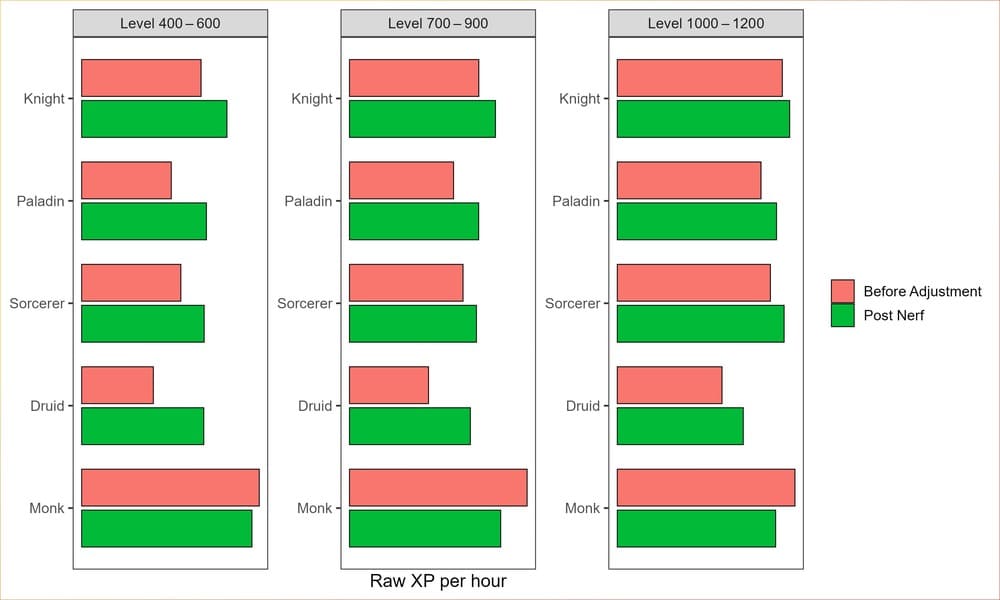
CipSoft compared the raw experience per hour earned by solo players before the balancing update with the results recorded after the July nerf.
Data from the period between the initial release and the nerf was not presented. The company only acknowledged that the results were even higher during that phase.
Even when considering only the post-nerf scenario, the difference is significant.
Between levels 400 and 600, the druid remains the vocation with the lowest solo experience, while the monk remains in first place.
Before the adjustments, the druid generated approximately 40% of the experience earned by the monk. After the changes and the nerf, that proportion rose to 72%.
Between levels 700 and 900, the weakest vocation previously generated around 45% of the experience earned by the strongest. It now reaches approximately 80%.
This means that the vocations have not become completely equal.
The gap, however, has been reduced very substantially. For CipSoft, this is one of the balancing update’s main positive results.
In our assessment, this is precisely where the most important part of the discussion begins.
Balancing should not mean delivering the same result
Bringing vocations that were very far apart closer together may be necessary.
No class should be so limited in solo play that it permanently depends on a team in order to progress. It would also be unhealthy for a single vocation to produce far superior results in virtually every scenario.
But balance does not have to mean equality. If each vocation has its own identity, it is natural for them to achieve different results.
The sorcerer, for example, is the class most directly associated with offensive power. In a structure truly based on class identity, it would be reasonable for it to have one of the highest solo experience potentials, even if that came with greater cost, fragility, and risk.
The druid has important healing and support tools. This does not mean it needs to be bad when playing alone, but it also does not require its experience per hour to be almost aligned with that of a vocation specialized in damage.
The monk was designed with a strong ability to play alone. Its presence among the best solo results therefore makes sense.
Knights and paladins also have their own advantages involving durability, stability, range, and versatility.
Vocations do not need to finish a hunt with exactly the same number in the analyzer to be considered balanced.
Ideally, each one should be strong in a different way. The concern raised in our analysis is that CipSoft acknowledges the importance of these identities in its text, but appears to use the convergence of experience-per-hour results as one of its main measures of success.
This can create characters with different rotations, spells, and playstyles that nevertheless end up producing increasingly similar results.
The way they are played changes. The final result, however, begins to look the same.
All vocations became stronger
The reduced gap between the classes was not the only conclusion presented.
The average power of characters also increased considerably.
Between levels 400 and 600, players are generating, on average, approximately 23% more raw experience per hour than before the balancing update.
In the 700 to 900 range, the average increase was 18%.
Between levels 1,000 and 1,200, the increase was smaller, but still reached 5%.
These results were measured after the nerf. During the first few days of the balancing update, before the reductions applied by CipSoft, the increase had been even greater.
This confirms that the nerf did not return the vocations to their previous state.
It only reduced part of the initial gain.
Even after the corrections, solo play became more efficient across every level range presented.
For players between levels 400 and 900, the change is especially relevant. An average increase of 18% or 23% changes the speed at which characters progress through this part of the game.
And that leads us to another question.
Do extremely advanced characters need to keep receiving buffs?
In the 1,000 to 1,200 range, the average increase was only 5%.
Even so, in our assessment, CipSoft needs to be very careful when increasing the power of characters who are already among the highest levels in the game.
Tibia has no final progression cap.
The more efficient a character becomes, the faster they reach the next level. By gaining new levels, they increase their attributes and become even more efficient, creating a continuous cycle of growth.
This also affects content development.
New hunts need to offer challenges and rewards suited to increasingly powerful characters. When that power rises quickly, recently released areas can become outdated sooner, and future content must be built around even higher numbers.
The criticism presented on the channel is that extremely advanced characters may not need buffs proportional to those received by mid-level ranges. In some cases, power growth could gradually decrease as the character’s level rises.
This does not mean taking away everything the player has earned.
It means preventing accelerated progression from making every future balancing update more difficult than the previous one.
CipSoft itself acknowledged that extreme levels need to be evaluated separately. This will probably be one of the most delicate aspects of the upcoming changes.
The monk remains ahead at lower levels
Another conclusion released by CipSoft concerns the monk.
Even after the adjustments and the nerf, the vocation remains ahead of the others in the lower ranges considered by the company.
At this point, the internal data and the perception expressed by part of the community do not appear to be fully aligned.
CipSoft did not explain exactly how these two readings differ. The company only stated that it intends to better understand the situation before making further adjustments.
This caution is positive.
The monk has already undergone several changes since its introduction. Making another immediate change based only on a partial impression could force the company to reverse course once again.
It is also necessary to understand why it appears at the top.
The issue may lie in its damage, equipment, selected hunting grounds, sustain, or simply in the fact that the monk was designed as a highly efficient vocation for solo play.
Being in first place does not automatically mean that it is broken.
The question is how large the advantage is and which tools allow it to exist.
CipSoft is looking at much more than experience
The chart released only shows raw experience per hour, but this is not the only data used internally.
CipSoft says it monitors kill rates, deaths, waste, boss participation, spell usage, and several other metrics.
This is essential because experience alone does not tell the whole story.
One vocation may produce less XP while spending much less. Another may achieve high results only in specific areas. A third may stand out in bosses, team hunts, or situations in which its role is not properly represented in a solo chart.
There is also a difference between average performance and the performance of the best players.
A vocation may appear balanced in the overall data but produce completely different results when played by characters with extremely expensive equipment, high skills, or complete mastery of its rotation.
For this reason, the chart helps explain the direction of the balancing process, but it does not end the discussion.
It shows the result, but it cannot show every cause on its own.
Further adjustments are still being prepared
CipSoft confirmed that it is continuing to work on smaller changes.
This time, however, it intends to proceed more cautiously to avoid another situation in which it releases a change and has to reverse it only a few days later.
This means that the next adjustments may take time.
The priorities mentioned are precisely the areas that received less attention in the first stage: extremely high-level characters and boss fights.
The June balancing update should therefore not be seen as a completed change.
It was the beginning of a broader process.
The company now has real data from characters playing on the official servers, fighting creatures, dying, using spells, and testing combinations that would be difficult to reproduce in full on a Test Server.
The next decisions will likely be narrower and more specific.
This reduces the chance of another abrupt change, but it also means that certain problems may take longer to be corrected.
Community feedback had an impact
CipSoft did not say that it was surprised by the amount of negative criticism.
What it officially stated was that it received an extraordinary volume of feedback and was unable to respond individually to everyone.
Even so, the sequence of events shows that the players’ reaction carried weight.
The balancing update was released.
Some of the results were far above expectations.
A nerf was applied.
The community continued debating.
Now, the company has published data, explained its internal process, and stated that it will be more careful before the next changes.
This reinforces the importance of well-constructed feedback.
Generic complaints rarely help identify a problem. Concrete examples, comparisons between hunts, and information about waste, bosses, equipment, and level ranges, on the other hand, can reveal situations that average data does not immediately show.
CipSoft may not respond to every post.
But that does not mean the comments are being completely ignored.
The balancing update improved the game, but the discussion is far from over
The data shows that the vocations became closer in performance and more powerful.
For many players, this represents a real improvement.
Druids gained more independence. Solo progression became less uneven. Characters between levels 400 and 900 can advance more quickly, and vocations that previously struggled to compete began achieving results closer to the others.
But closer figures do not automatically represent a better-balanced game.
The real challenge is to make every vocation viable without making all of them deliver practically the same thing.
Sorcerers need to feel offensive. Druids need to remain relevant as support. Knights should convey durability and control. Paladins need to preserve their versatility. Monks should justify their identity in solo play without becoming the most efficient answer to every situation.
This differentiation does not need to exist only in the spells they use. It needs to appear in the results, costs, risks, and roles performed by each class.
CipSoft’s publication is an important step forward because it finally provides concrete data for the discussion. It confirms that the balancing update increased overall power, narrowed the gap between the vocations, and will still be modified.
It now remains to be seen which direction the company will take. CipSoft may continue bringing the figures closer together until all classes achieve similar results.
Or it may use the next adjustments to build something more difficult, but also more interesting: vocations that are truly balanced precisely because they are not the same.
Comments
0